
Executive judgment
There is an AI investment boom. That is not a metaphor: capital, power, chips, data centers, and market attention have all been moving at exceptional speed. There is also real demand, real revenue, and real technical capability. Calling all of it fraud, vaporware, or “just another dot-com” is not supported by the evidence.
The more uncomfortable truth is that a genuine technological breakthrough and a financial bubble can coexist. The question is not whether AI works. It plainly does, in a growing number of uses. The question is whether the value ultimately created by AI will be large enough, soon enough, and broadly enough distributed to justify the infrastructure bill, the market prices, and the financing assumptions now being made around it.
That answer is unknown. The evidence supports a sharper conclusion: the system is vulnerable where future earnings expectations, concentrated suppliers and buyers, power constraints, and increasingly external financing meet. The most likely outcome is not necessarily a single dramatic “AI crash.” It may instead be a sequence: capacity bottlenecks, margin pressure, project cancellations, valuation resets, consolidation, and—eventually—durable adoption by the survivors.
What an “AI bubble” actually means
A bubble is not simply a high stock price or a popular technology. It is a period in which asset prices and investment commitments become dependent on expectations that are difficult to meet under ordinary economics. The mechanism is usually self-reinforcing: rising prices make funding easier; funding increases spending and reported growth; the growth validates higher prices; and the cycle continues until cash flows, financing conditions, or demand break the loop.
Applied to AI, the concern is not that chips, models, or automation are imaginary. The concern is a possible mismatch among four clocks:
- Infrastructure spending happens now. Data centers, chips, networks, cooling, grid upgrades, and power contracts require enormous up-front capital.
- Revenue is partly real but still immature. Many firms report use and early savings, yet evidence of broad, durable, high-margin returns remains thinner than evidence of deployment.
- Asset lives may be short. AI hardware can be displaced quickly by newer generations, which raises the risk that depreciation schedules and utilization assumptions prove optimistic.
- Financial expectations are immediate. Public markets and private funding often price years of future profit into today’s valuation.
That mismatch is the core of the bubble thesis. It is neither proof of a crash nor a defense of the status quo.
How the boom happened
1. A credible technical discontinuity met a cloud-and-chip machine already built to scale
Modern generative AI demonstrated capabilities that were legible to buyers: writing, coding assistance, search, customer support, analysis, image generation, and workflow automation. Unlike many earlier technology narratives, the products reached consumers and businesses rapidly.
The adoption signal is genuine. Stanford’s 2025 AI Index reported that the share of surveyed organizations using AI rose from 55% in 2023 to 78% in 2024; reported use of generative AI in at least one business function rose from 33% to 71%. The same report found reported cost savings and revenue gains in several functions, but noted that the most common reported savings level was below 10%. That distinction matters: widespread experimentation is not the same as economy-wide profit transformation.[1]
2. Supply concentrated, and the supplier boom became visible in financial results
NVIDIA’s fiscal-2025 filing reported Data Center revenue of $115.2 billion, up 142% year over year, driven by demand for accelerated computing used in large language models, recommendation engines, and generative-AI applications.[2] This is powerful evidence against the claim that the AI boom is purely fictional. Customers are buying real hardware at scale.
It is also a concentration warning. When a small number of suppliers, hyperscalers, and large buyers drive a large share of the buildout, a reduction in a few spending plans can travel rapidly through the chain. NVIDIA itself identifies changing end-user demand, competitive products, and demand for AI-related cloud services or large language models as risks to demand.[2]
3. The physical constraint moved from chips toward energy, grids, and construction
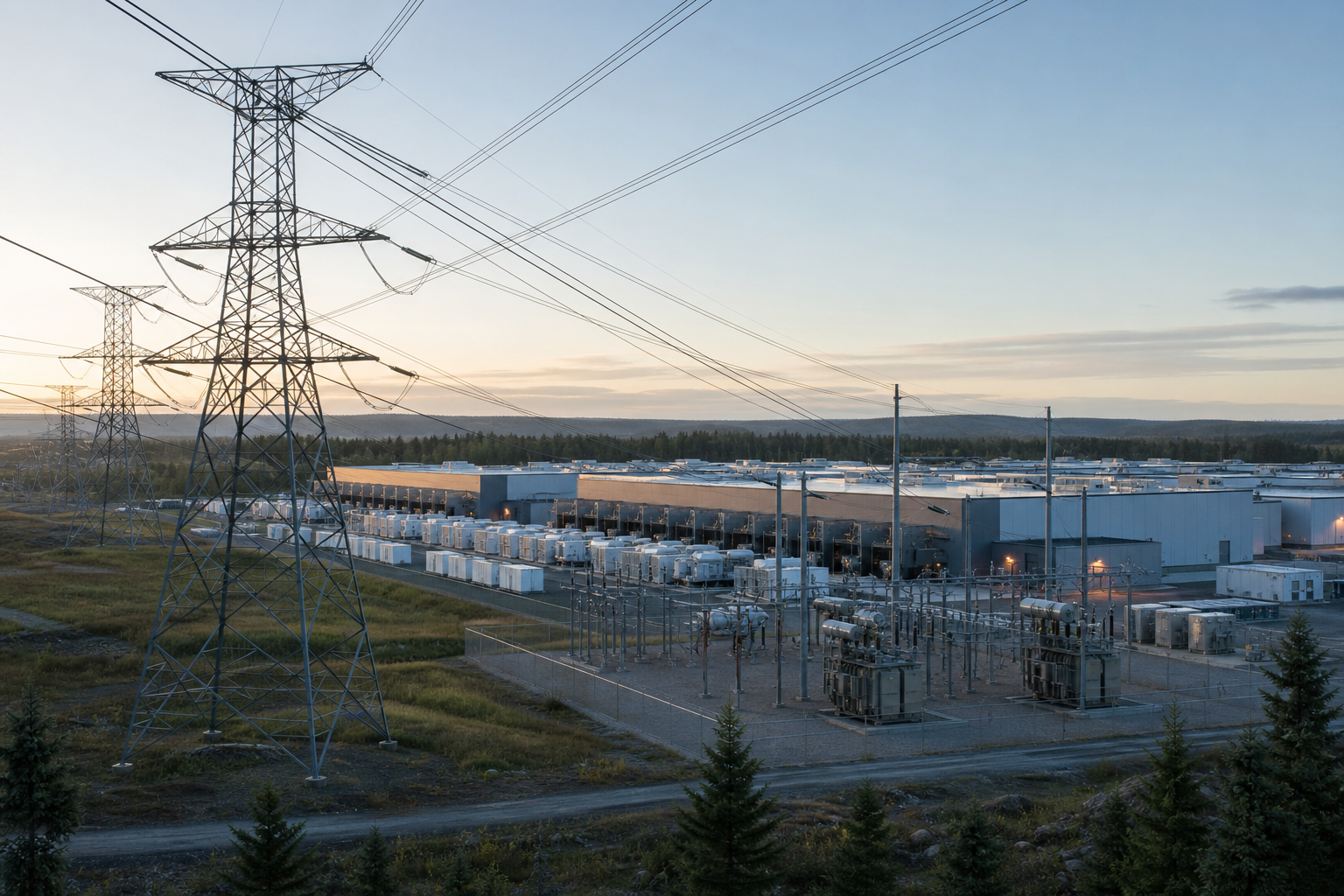
AI is not merely software. The International Energy Agency estimates that data centers consumed roughly 415 TWh of electricity in 2024—about 1.5% of global use—and projects about 945 TWh by 2030 in its base case. It emphasizes uncertainty: its alternative cases range from a demand plateau around 700 TWh in 2035 to more than 1,700 TWh.[3]
This creates a two-sided reality. The power problem can slow deployment and make some planned projects uneconomic. But it also means the spend is building physical capacity that can have use beyond a single AI application. A delayed data center is not the same thing as an empty website from 2000; it is still a costly asset whose return depends on utilization.
4. Financing is becoming a more important part of the story
The Bank for International Settlements (BIS) says the scale of anticipated AI investment will require a shift from operating cash flow toward debt, with private credit playing an increasing role. It reports that, by mid-2025, US spending on IT manufacturing facilities and data centers (including equipment and construction) was equivalent to about 1% of GDP; total IT-related investment reached 5% of GDP, above its dot-com-era peak.[4]
That is the non-sensational version of the “circular financing” concern. Debt-funded investment is not fake revenue. A vendor sale may be completely legitimate even if the buyer financed it. The risk arises if financing enables capacity faster than end-user economics justify, or if the same concentrated ecosystem relies on each member continuing to spend. Assertions of a single closed loop of fraudulent AI revenue require transaction-specific evidence; broad rhetoric is not evidence.
The real risks
The revenue-versus-capex gap
The central risk is that AI services become useful without becoming sufficiently profitable to pay for the compute layer at current prices. Early deployment can produce modest productivity gains while still failing to clear the cost of inference, model training, sales, integration, security, and depreciation. A company can have strong user growth and weak unit economics at the same time.
Overbuilding and obsolescence
If providers build capacity for demand that arrives later, assets can sit underutilized. If the hardware race remains intense, older accelerators may be economically superseded before their financing has been earned back. This is a normal capital-cycle problem made harsher by short product cycles and high fixed costs.
Valuation and concentration
A narrow group of large technology firms and suppliers has carried an outsized portion of AI spending and market optimism. A valuation correction need not imply that AI has failed; it can simply mean that the market priced success too far ahead of realized cash flow. The adverse effect becomes larger when indexes, retirement portfolios, credit markets, and data-center supply chains are similarly concentrated.
Power, water, local politics, and execution
Electricity is a location-specific constraint. The IEA notes that concentrated loads can be harder for grids to absorb than their global share suggests.[3] Permitting, transmission, generation, cooling, water, transformers, and community acceptance can turn a theoretical model-demand forecast into a delayed or canceled project.
Labor and distributional risk
The labor story is not “AI will eliminate all jobs,” nor is it “AI only helps workers.” The IMF finds that AI exposure is broad and that the balance between displacement, complementarity, and productivity determines the outcome. It warns that capital income and wealth inequality can rise even in scenarios where productivity lifts total income.[5] The economic benefit can be real while the distribution of that benefit is politically destabilizing.
Safety, trust, and regulation
The report’s focus is financial, but non-financial failures can become financial ones. Model errors, privacy breaches, copyright disputes, cybersecurity misuse, safety incidents, and regulatory restrictions can raise the cost of deployment or undermine buyer trust. These risks particularly matter when valuations assume fast, frictionless adoption.
What could happen next
Scenario A — Productive normalization (constructive)
AI improves workflows enough to justify much of the infrastructure. Costs per useful task fall, enterprises redesign processes instead of merely adding chatbots, and model providers find durable pricing power in selected domains. Valuations may still compress, but the technology diffuses broadly—similar to past general-purpose technologies whose early infrastructure spending was excessive in parts but valuable in aggregate.
What would support it: sustained enterprise spending without subsidy-like pricing; rising utilization; clear cash-flow conversion; falling inference costs; and measurable productivity gains beyond pilot programs.
Scenario B — The digestion phase (base case)
Buildout outruns monetization for a time. Providers slow capex growth, negotiate harder with suppliers, cancel marginal projects, and consolidate. Some investors lose heavily, but the infrastructure remains useful and is acquired or used more cheaply by survivors. This is the most plausible path if AI is important but present expectations are too high.
What it looks like: uneven earnings, lower multiples, price wars in model services, regional power delays, and a widening gap between profitable AI applications and expensive general-purpose experiments.
Scenario C — Financial repricing and credit stress (downside)
Demand or prices disappoint while financing costs rise. Highly levered or poorly contracted projects struggle; private-credit losses surface; cloud and equipment orders are cut; equity valuations fall sharply. This would be damaging, but it would not demonstrate that AI itself was worthless. It would demonstrate that capital allocation and financing assumptions were wrong.
What would warn of it: material increases in canceled capacity, falling utilization, deferred hardware orders, deterioration in vendor receivables, financing terms tightening, and companies revising return-on-investment language downward.
Bottom line
The AI boom is real. So are its dangers. The strongest honest conclusion is not “AI is a bubble” or “AI cannot be a bubble because the technology works.” It is that a transformative technology is being financed at a scale that leaves little room for execution mistakes.
The definitive test will be boring, not theatrical: cash flow after capex, utilization after buildout, prices after competition, and productivity after organizations actually change how work is done. If those numbers catch up, today’s spending will look prescient. If they do not, the narrative will not save the capital already committed.
Sources
- Stanford Human-Centered Artificial Intelligence, 2025 AI Index Report — Economy
- NVIDIA Corporation, Form 10-K for fiscal year ended 26 January 2025
- International Energy Agency, Energy demand from AI
- Bank for International Settlements, Financing the AI boom: from cash flows to debt
- International Monetary Fund, Gen-AI: Artificial Intelligence and the Future of Work